KACST Harnesses Nuclear Technologies to Protect Cultural Heritage in Collaboration with Heritage Commission and IAEA
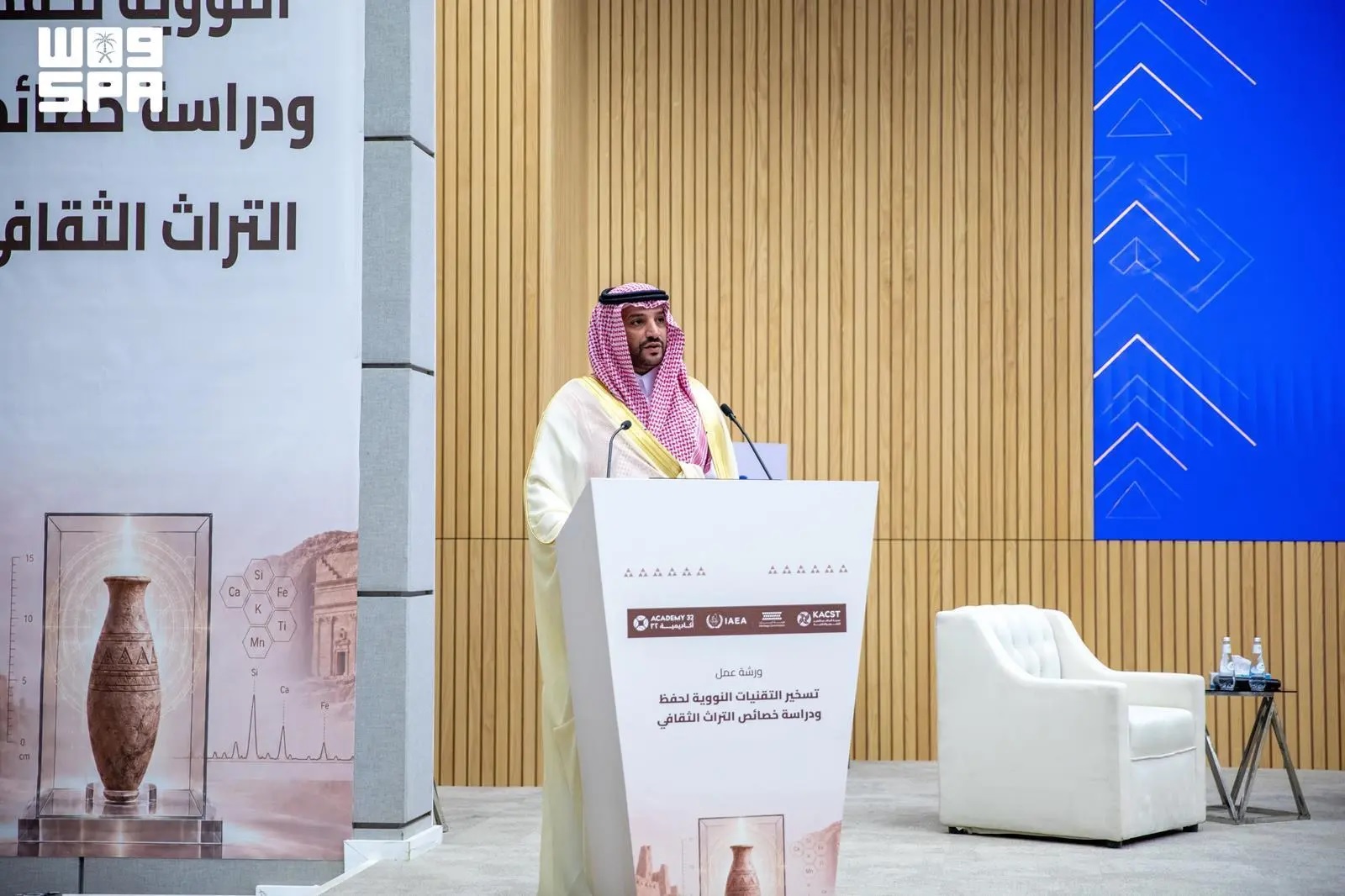
King Abdulaziz City for Science and Technology (KACST) concluded today the workshop on “Harnessing Nuclear Technologies for the Preservation and Study of Cultural Heritage Properties,” organized by KACST in collaboration with the Heritage Commission and the International Atomic Energy Agency (IAEA), with the participation of 10 national entities and a group of international experts and specialists.
In his remarks, Chief Executive Officer of the Heritage Commission Dr. Jasser Al-Harbash commended the partnership with KACST in employing advanced technologies for the precise surveying of the Kingdom’s urban and archaeological heritage, as well as the use of mapping and satellite imaging. He noted that the commission has registered more than 55,000 urban heritage buildings, 14,000 archaeological sites, and thousands of archaeological artifacts.
KACST Vice President for the Energy and Industry Sector Dr. Saeed Al-Shihri stated that KACST has developed advanced national capabilities in nuclear sciences and technologies in the field of heritage, supported by 14 specialized laboratories and more than 100 Saudi researchers, engineers, and technicians.
Dr. Al-Shihri explained that the workshop aims to connect scientific capabilities with the needs of the Kingdom’s heritage sector, establishing a national pathway that contributes to setting priorities, developing joint methodologies, building competencies and reference databases, and ultimately creating a sustainable ecosystem that links science and technology with the protection and study of heritage.
International Atomic Energy Agency's expert Dr. Assaad Seif noted that the value of illicit trafficking in cultural property across the Arab world amounts to approximately $6 billion annually. He explained that this reality prompted the launch of a project focused on recovering and preserving antiquities by strengthening partnerships and cooperation with Arab and international organizations and institutions.
He added that the use of nuclear and physical technologies, alongside the development of protocols and policies, has become essential to the protection of cultural heritage.
During the panel discussions, participants addressed the role of nuclear technologies in scientifically verifying the authenticity and provenance of cultural heritage objects, as well as the use of analytical techniques to study the properties of artifacts and verify their authenticity. They also reviewed international experiences and the current use of analytical technologies in the Kingdom to protect its cultural heritage.
The workshop also included a training program at KACST’s Academy 32, with more than 50 participants. The program focused on developing specialists’ capabilities in selecting appropriate analytical techniques for studying archaeological artifacts, interpreting results, and linking those results to the archaeological and historical context of the objects, thereby supporting the development of national expertise capable of applying these technologies to the study and protection of cultural heritage.
The workshop was organized as part of the regional technical cooperation project aimed at combating illicit trafficking in antiquities and works of art, developing specialists’ capabilities in selecting analytical methods and interpreting their results, and identifying future opportunities for applying these technologies in the heritage sector, thereby strengthening national competencies in safeguarding cultural property.